


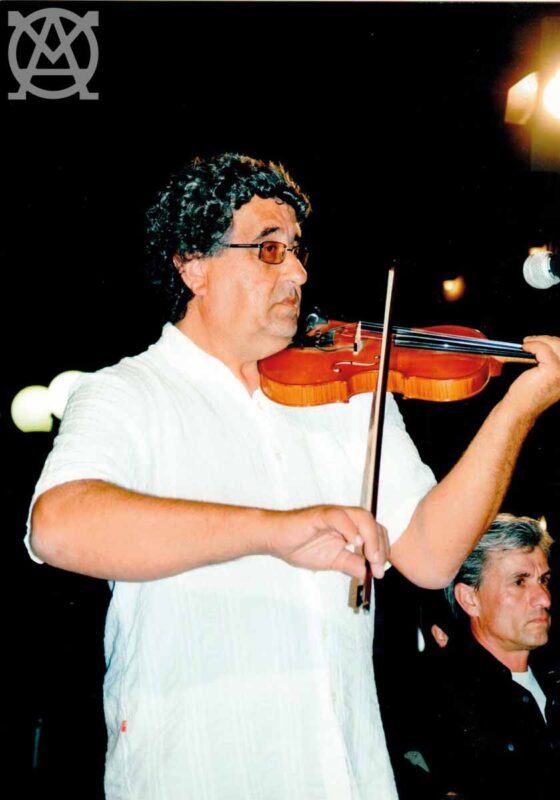
NAME: Markos Gavras of Iakovos and Evangelia – son of Iakovos M. Gavras (1907-1979) and father of Iakovos (Giakoumis) M. Gavras (1990) and Georgios M. Gavras (1994)
PLACE OF BIRTH: Ηora, Amorgos
PLACE OF DEATH: Athens
PLACE OF RESIDENCE: Amorgos
SPOUSE / MAIDEN NAME: Maria of Georgios Prasinos / Prasinou
PROFESSION: Public Servant
INSTRUMENT: Violin, Lute, Singer
BIOGRAPHICAL NOTE
Markos Gavras was a violinist, lute player, and singer, with an active presence in the musical life of Amorgos from the early 1980s. He was born and lived in Chora, Amorgos. From an early age he grew up in a home where instruments were always present (violin, lute, mandolin, guitar), and he listened to his father playing at weddings, village festivals, and Carnival celebrations. A characteristic childhood memory is that, returning home from primary school, he secretly took his father’s violin and played a phrase from a song he had learned at school; this moment seems to have confirmed to his father his musical “ear” and natural talent.
His father, Iakovos M. Gavras, was an amateur musician who played violin, lute, mandolin, and guitar. He worked in Athens before and after the war, retired relatively early, and returned to Amorgos, where he married at an advanced age; he had Markos when he was about 55. Although Markos did not have the chance to apprentice systematically under him (his father died a few months after Markos graduated from high school), he remembered him as a musician with broader knowledge: he improvised on the lute, played waltzes, rebetika, and even tunes from the Ioanian islands. An important figure in the family memory is also his father’s sister, Anna Gavras, who—according to older testimonies—was highly sociable, with a “strong” voice and exceptional skill on the mandolin.
After adolescence, Markos Gavras was forced to leave Amorgos to complete the final grades of high school off the island. Upon returning, and after his father’s death, a decisive impetus for beginning serious study came from a cassette recording of a celebration in Chora, where he heard his father playing violin. Guided by that sound and through long hours of daily practice, he attempted to “copy” the playing, discovering in the process that he had an exceptionally good ear. At the same time, he turned to the lute under the guidance of Leonidas G. Vlavianός (a lute player/singer and collaborator of his father), from whom he learned the “Amorgian” approach to accompaniment and melodic handling (rhythm, trills/double trills, and executing the tune on the lower string of the laouto). What he mastered on the lutee he later transferred to the violin, also making use of the distinctive Amorgian “ala tourka” tuning (Sol–Re–La–Re), which he regarded as a pivotal element of the local sound color.
His first public/professional appearance took place in 1981, when he played at a café in Chora with the local violinist and singer Giorgos A. Nomikos (“Kazantzidis”). He described this experience as a “baptism of fire” and as the starting point for gaining the personal confidence to serve the Amorgian style. In the decades that followed, he participated in festivals and celebrations, focusing mainly on the local repertoire and the playing techniques associated with it.
A major milestone in his musical development was his acquaintance, in the early 1990s, with the philologist and music connoisseur Theodoros Koutsovangelis, who taught students (including him) basic elements of reading music, meter, and musical notation. With his help, Markos improved his technique, took part in concert activity, and expanded his repertoire toward modern Greek art song (Theodorakis, Hatzidakis, Markopoulos, etc.). Later, he followed and drew on the knowledge and discographic output of his contemporary Nikolaos D. Oikonomidis (a violinist and singer from Schoinousa), whom he regarded as a point of reference, while still remaining devoted to his own style.
Alongside secular music, he also cultivated Byzantine chant: from childhood he listened to radio broadcasts from the Metropolis of Athens, especially the Protopsaltis Spyros Peristeris, whom he later came to know personally. From the mid-1980s he began chanting in church, largely self-taught, relying chiefly on his ear and memory. In 2001, on the occasion of the reception of the icon of Panagia Hozoviotissa in Athens, he chanted at the Metropolis of Athens on the right choir stand, an experience he described as a pinnacle.
In his musical thinking he emphasized the affinity between modes/echoi of Byzantine music and Amorgian tunes (e.g., linking the Amorgian Mantinada with the First Echos and the “Thermiotikos” with the Second), without, of course, equating singing with the art of chanting. As for the local repertoire, he believed that—even if many tunes have roots outside Amorgos (Asia Minor, Constantinople, etc.)—they have been “grafted” onto the island and now constitute a local repertoire through their distinctive performance style and their social function in Amorgos’ festivals.
He was married to Maria Prasinou and was the father of two children, Iakovos (Giakoumis) and Giorgos, who, drawing on their father’s experience and the wider circle of Amorgian musicians, continue the family tradition by working professionally in music.